


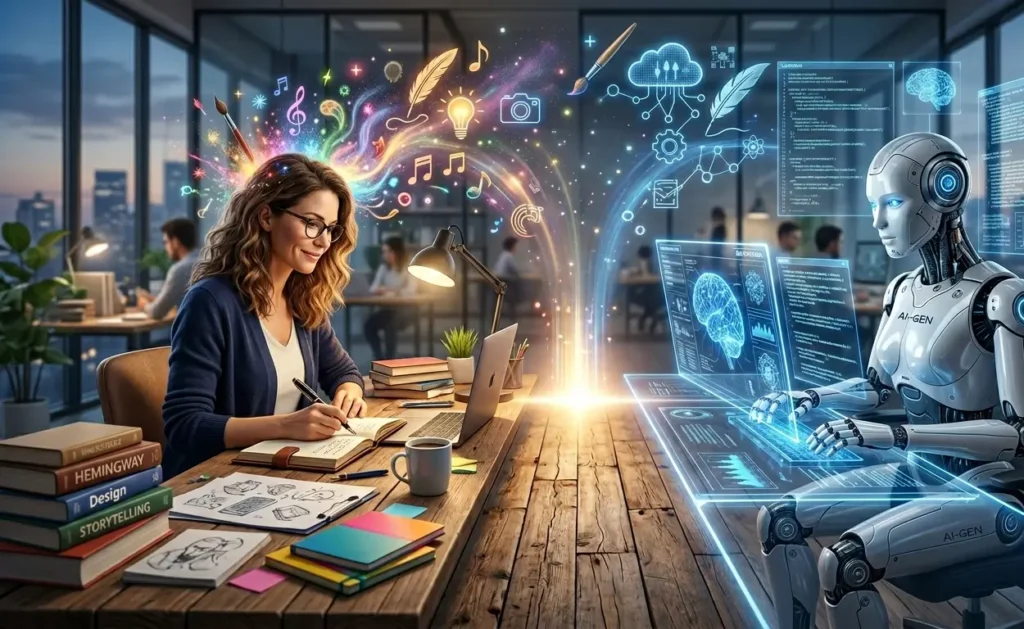
Explore how technology is transforming content creation, compare AI and human creativity, and discover whether machines can truly replace writers.
The rapid advancement of technology has transformed nearly every aspect of modern life, including the way content is created. Artificial intelligence (AI) can now generate blog posts, marketing copy, social media captions, product descriptions, and even creative stories within seconds. As these tools become more sophisticated, an important question continues to emerge: Can machines replace writers?
The debate between AI and human creativity is one of the most significant discussions in the digital age. While AI-powered writing tools offer speed, efficiency, and scalability, human writers bring imagination, emotion, cultural understanding, and critical thinking to their work. Both have strengths and limitations, making the future of content creation more complex than a simple competition between humans and machines.
For businesses, marketers, educators, and content creators worldwide, understanding the relationship between technology and creativity is essential. Rather than viewing AI as a threat, many experts see it as a tool that can enhance human capabilities and improve productivity.
Key Takeaways
- AI writing tools can generate content quickly and efficiently.
- Human creativity remains essential for emotional depth and originality.
- Technology is changing the writing industry rather than eliminating it.
- Businesses can achieve better results by combining AI and human expertise.
- The future of content creation will likely involve collaboration between writers and AI systems.
Understanding AI Writing Technology
Artificial intelligence writing technology refers to software systems that generate text using machine learning and natural language processing. These systems analyze large amounts of text data and learn patterns, structures, grammar, and writing styles.
Modern AI tools can perform various writing-related tasks, including:
- Drafting articles
- Creating marketing content
- Generating product descriptions
- Producing social media posts
- Summarizing information
- Assisting with research
The growing popularity of AI writing platforms demonstrates how technology is becoming an important part of content creation workflows. Businesses increasingly use AI to improve efficiency and reduce production time.
Website owners interested in digital transformation may also find value in linking to:
[Insert Internal Link: Technology Tools for Modern Businesses]
What Is Human Creativity?

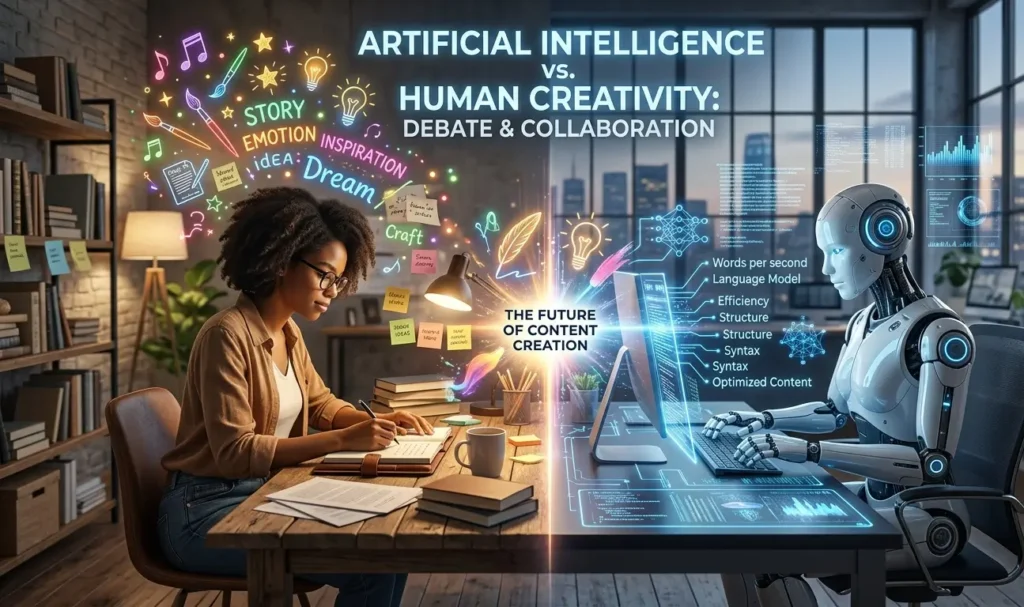
Human creativity is the ability to generate original ideas, concepts, emotions, and solutions through imagination and personal experience. Unlike AI, human creativity is shaped by culture, emotions, memories, intuition, and life experiences.
Writers often draw inspiration from:
- Personal experiences
- Social interactions
- Historical events
- Emotional connections
- Cultural influences
- Creative experimentation
Human creativity allows writers to produce content that resonates deeply with readers. It enables storytelling, humor, empathy, persuasion, and artistic expression that often goes beyond patterns and data.
Creative writing is not simply about arranging words correctly. It involves understanding human emotions, recognizing subtle meanings, and crafting messages that connect with audiences on a personal level.
How AI Generates Content
AI systems generate content through complex algorithms trained on extensive datasets. Rather than thinking like humans, AI predicts the most likely sequence of words based on patterns learned from previous examples.
The process generally involves:
Data Training
AI models analyze large collections of books, articles, websites, and other textual sources to understand language structures.
Pattern Recognition
The system identifies relationships between words, phrases, and concepts.
Text Prediction
When given a prompt, AI predicts which words are most likely to follow based on its training data.
Content Generation
The model produces complete sentences, paragraphs, and articles that appear natural and coherent.
Although the results can be impressive, AI does not possess genuine understanding, emotions, or personal experiences. It relies entirely on statistical patterns and learned language relationships.
Strengths of AI in Content Creation
AI offers several advantages that make it attractive for businesses and content creators.
Speed and Efficiency
One of the greatest strengths of AI is its ability to create large volumes of content within minutes. Tasks that may take a writer several hours can often be completed much faster with AI assistance.
Scalability
Organizations producing large amounts of content can use AI to scale operations efficiently. This is particularly valuable for e-commerce businesses, digital publishers, and marketing agencies.
Cost Savings
For routine content tasks, AI can help reduce production costs and improve operational efficiency.
Consistency
AI can maintain consistent tone, formatting, and style across multiple pieces of content.
Research Assistance
Writers can use AI to generate outlines, summarize information, and brainstorm ideas more quickly.
Businesses exploring digital growth strategies may also benefit from:
[Insert Internal Link: How Artificial Intelligence Is Changing Digital Marketing]
Strengths of Human Writers
While AI provides efficiency, human writers possess unique strengths that remain difficult for machines to replicate.
Emotional Intelligence
Humans understand emotions because they experience them directly. This allows writers to create content that inspires, motivates, entertains, and connects with readers.
Original Thinking
Human creativity often produces entirely new ideas rather than combinations of existing patterns.
Contextual Understanding
Writers understand cultural references, social nuances, and situational context that may be challenging for AI systems.
Ethical Judgment
Humans can evaluate the ethical implications of content and make responsible decisions based on values and societal standards.
Storytelling Ability
Powerful storytelling remains one of the most valuable skills in communication. Human writers excel at creating compelling narratives that engage audiences.
Content creators focused on audience engagement may also consider:
[Insert Internal Link: Benefits of Content Marketing]
AI vs Human Creativity: Key Differences
Although AI and human writers can both create content, their approaches differ significantly.
AI relies on data, algorithms, and pattern recognition. Human creativity relies on imagination, emotions, experiences, and intuition.
AI excels at speed and repetition. Humans excel at innovation and emotional connection.
AI can assist with information processing and content generation. Humans provide authenticity, strategic thinking, and meaningful insights.
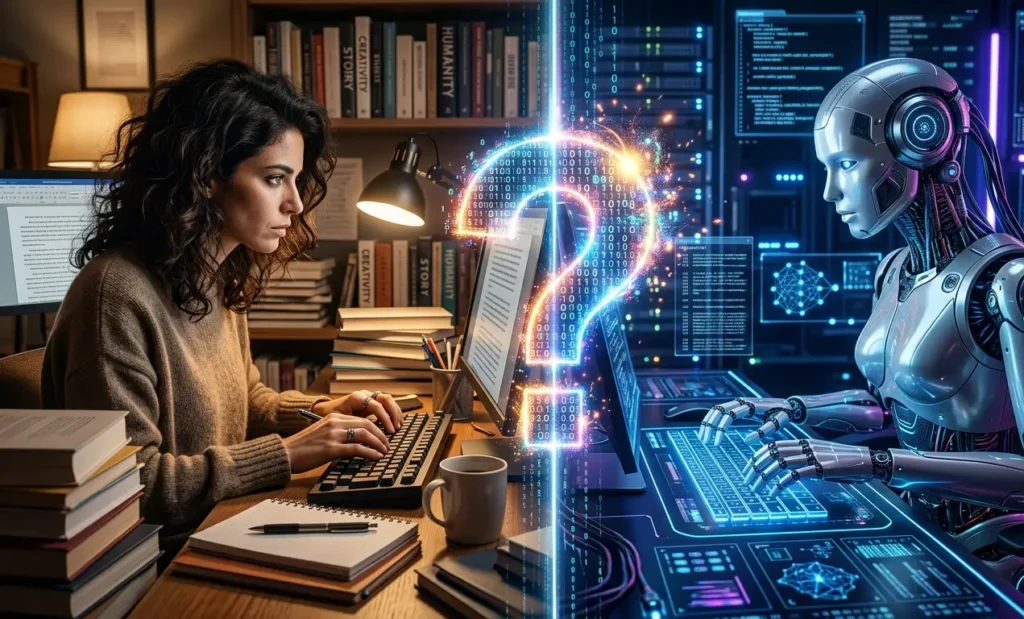
These differences suggest that AI and human creativity may serve complementary roles rather than competing directly.

Expert Insights on the Future of Writing
Industry experts increasingly agree that the future of writing will be shaped by collaboration between humans and artificial intelligence rather than competition between the two.
AI technology is expected to become more advanced, helping writers research topics, organize information, improve productivity, and optimize content for search engines. However, the qualities that make writing truly impactful—such as empathy, creativity, originality, and emotional intelligence—will remain uniquely human strengths.
Businesses that rely entirely on AI-generated content may struggle to build authentic relationships with their audiences. On the other hand, organizations that combine AI efficiency with human expertise are likely to gain a competitive advantage.
Many successful content teams already use AI for routine tasks while allowing human writers to focus on strategy, storytelling, audience engagement, and brand development. This balanced approach is expected to become the standard model for content creation in the years ahead.
Practical Tips for Businesses and Content Creators
To benefit from both AI and human creativity, consider the following best practices:
Use AI for Research and Planning
AI can quickly generate topic ideas, outlines, and content frameworks, helping teams save time during the planning stage.
Maintain Human Editorial Oversight
Every piece of AI-assisted content should be reviewed by a qualified writer or editor to ensure accuracy, quality, and consistency.
Prioritize Audience Value
Focus on creating helpful, trustworthy, and engaging content rather than simply publishing large quantities of material.
Develop a Unique Brand Voice
A distinctive brand voice helps businesses stand out in competitive markets. Human writers play a key role in maintaining authenticity.
Related article:
[Insert Internal Link: How to Build a Strong Online Brand]
Combine Creativity with Technology
The most effective content strategies use technology to improve efficiency while preserving human creativity and originality.
Focus on Quality Over Quantity
Search engines increasingly reward content that demonstrates expertise, experience, authority, and trustworthiness.
Related article:
[Insert Internal Link: Common Marketing Mistakes Businesses Should Avoid]
Frequently Asked Questions
1. Can AI completely replace human writers?
Currently, AI cannot completely replace human writers. While AI can generate text efficiently, human creativity, emotional intelligence, and critical thinking remain essential for producing meaningful and engaging content.
2. Is AI-generated content good for SEO?
AI-generated content can support SEO efforts when properly reviewed and optimized by humans. High-quality, accurate, and user-focused content remains the most important factor for search engine rankings.
3. What types of content can AI create?
AI can create blog posts, product descriptions, social media content, marketing copy, email campaigns, summaries, and informational articles. However, complex creative projects often benefit from human involvement.
4. Why is human creativity still important?
Human creativity allows writers to produce original ideas, emotional connections, cultural insights, and compelling stories that resonate with audiences.
5. Can businesses rely entirely on AI content?
Businesses should avoid relying entirely on AI-generated content. Human oversight helps maintain quality, accuracy, authenticity, and brand credibility.
6. What are the biggest advantages of AI writing technology?
The primary advantages include speed, efficiency, scalability, consistency, and cost-effectiveness for repetitive content tasks.
7. What are the main disadvantages of AI writing technology?
AI may produce inaccurate information, lack emotional depth, generate generic content, and struggle with complex context or nuanced subjects.
8. How can writers benefit from AI tools?
Writers can use AI for brainstorming, outlining, research assistance, editing support, and productivity improvements while focusing their efforts on creativity and strategic thinking.
9. Will AI create new opportunities for writers?
Yes. As AI adoption grows, writers may find new opportunities in content strategy, editing, AI content supervision, prompt engineering, and specialized creative work.
10. What is the future relationship between AI and human writers?
Most experts believe AI and human writers will work together. AI will handle repetitive tasks, while humans will provide creativity, judgment, emotional intelligence, and originality.
Conclusion
The debate surrounding AI vs human creativity continues to evolve as technology advances at an unprecedented pace. Artificial intelligence has already transformed content creation by improving efficiency, reducing production time, and helping businesses scale their operations. Its ability to generate text quickly makes it a valuable tool for marketers, publishers, and organizations worldwide.
However, despite these impressive capabilities, AI remains fundamentally different from human creativity. Machines can analyze patterns and generate content, but they do not experience emotions, understand personal experiences, or create ideas through genuine imagination. Human writers bring empathy, originality, cultural understanding, and storytelling skills that remain difficult for technology to replicate.
Rather than asking whether machines will replace writers, a more practical question may be how humans and AI can work together effectively. The future of content creation is likely to be a partnership where technology handles routine tasks while human writers focus on creativity, strategy, and meaningful audience connections.
Businesses, marketers, bloggers, and content creators who embrace this balanced approach will be better positioned to succeed in an increasingly digital world. As technology continues to evolve, human creativity will remain one of the most valuable assets in producing content that informs, inspires, and connects with people across the globe.