
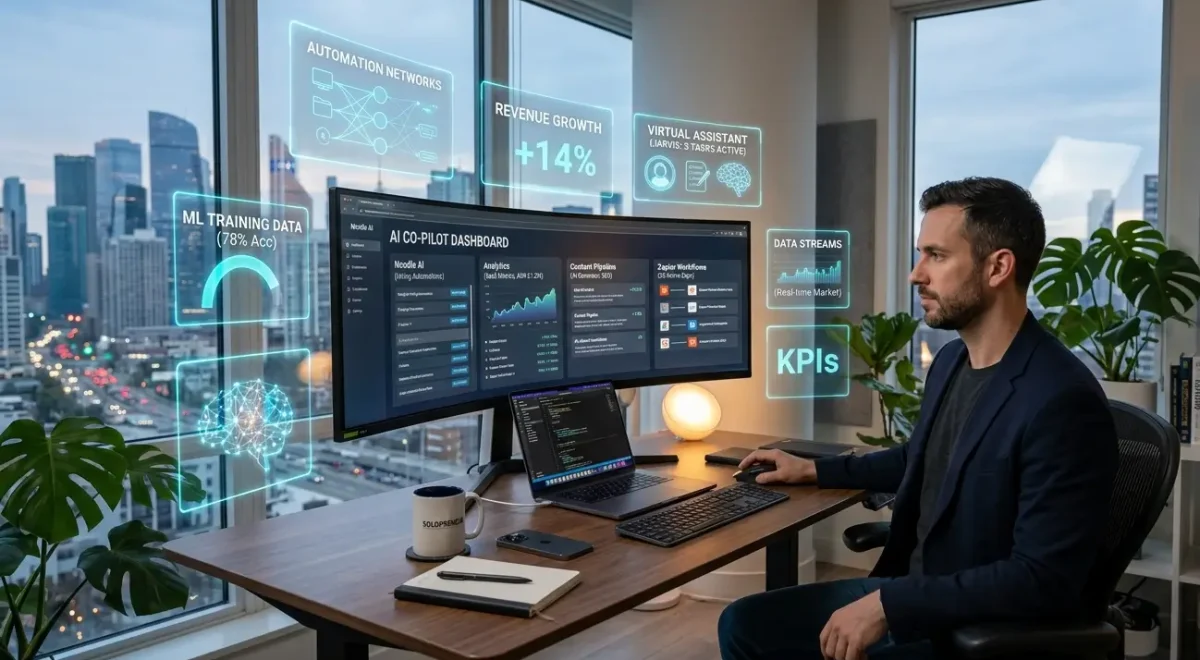
In today’s digital economy, AI is transforming how entrepreneurs work, create, and grow their businesses. For solopreneurs who manage multiple responsibilities alone, building an AI-first workspace can significantly improve productivity, reduce workload, and create new opportunities for growth. An AI-first workspace is not just about using a few tools; it is about designing a system where AI supports daily operations, decision-making, content creation, customer service, and business management.
What Is an AI-First Solopreneur Workspace?
An AI-first workspace is a work environment where AI tools are integrated into core business processes. Instead of performing repetitive tasks manually, solopreneurs use AI to automate workflows, generate insights, and increase efficiency.
This approach allows business owners to focus more on strategic activities such as innovation, customer relationships, and revenue generation while AI handles routine tasks.
Why Solopreneurs Need AI
Running a business alone often means wearing many hats. A solopreneur may be responsible for marketing, customer support, administration, content creation, accounting, and sales. AI helps reduce this burden by automating time-consuming activities.
Key benefits of AI include:
- Increased productivity
- Faster content creation
- Better customer support
- Improved data analysis
- Reduced operational costs
- Enhanced decision-making
- Greater scalability
By leveraging AI effectively, solopreneurs can compete with larger businesses without hiring a large team.
Essential Components of an AI-First Workspace
1. AI-Powered Content Creation
Content remains one of the most effective ways to attract and engage customers. AI tools can help generate blog posts, social media content, email campaigns, product descriptions, and marketing materials.
Benefits include:
- Faster writing processes
- Consistent content production
- Improved idea generation
- Better content optimization
AI can assist with research, drafting, editing, and SEO optimization, helping solopreneurs maintain an active online presence.
2. AI for Task Management
Managing multiple projects can become overwhelming. AI-powered productivity tools help organize schedules, prioritize tasks, and automate reminders.
These systems can:
- Track deadlines
- Recommend priorities
- Schedule meetings
- Automate recurring tasks
- Improve workflow management
A structured workspace supported by AI reduces stress and helps maintain focus on important goals.
3. AI Customer Support Systems
Customer satisfaction is critical for business success. AI chatbots and virtual assistants can provide immediate responses to customer inquiries, improving response times and user experience.
Advantages include:
- 24/7 customer support
- Faster response rates
- Reduced support workload
- Improved customer satisfaction
Even small businesses can deliver professional support experiences using AI technology.
4. AI for Marketing Automation
Marketing requires continuous effort and consistency. AI simplifies many marketing activities by automating campaigns, analyzing customer behavior, and optimizing content performance.
Marketing applications include:
- Email marketing automation
- Audience segmentation
- Social media scheduling
- Ad campaign optimization
- Customer behavior analysis
This enables solopreneurs to reach more customers while spending less time on manual marketing tasks.
5. AI-Driven Data Analysis
Business decisions should be based on data rather than assumptions. AI can analyze large amounts of information quickly and provide actionable insights.
Examples include:
- Website performance tracking
- Sales analysis
- Customer trends
- Market research
- Revenue forecasting
With AI-powered analytics, solopreneurs can identify opportunities and make informed business decisions.
Building the Ideal AI Workflow
Creating an AI-first workspace requires a structured workflow. Each business activity should be connected through automation where possible.
A simple workflow may include:
- AI generates content ideas.
- AI assists in content creation.
- AI schedules content distribution.
- AI monitors performance.
- AI analyzes results.
- AI provides recommendations for improvement.
This continuous cycle creates an efficient system that supports long-term business growth.
Common Mistakes to Avoid
While AI offers significant advantages, it should not replace human judgment entirely.
Avoid these common mistakes:
- Over-automating customer interactions
- Publishing AI-generated content without review
- Ignoring data privacy concerns
- Relying on a single AI tool
- Neglecting brand voice and authenticity
The best results come from combining AI efficiency with human creativity and strategic thinking.
Future of the AI-First Solopreneur
As AI technology continues to evolve, solopreneurs will gain access to even more advanced capabilities. Businesses that adopt AI early can improve efficiency, reduce costs, and position themselves for future growth.
Emerging developments include:
- Smarter virtual assistants
- Advanced predictive analytics
- Personalized customer experiences
- Enhanced workflow automation
- AI-powered business management systems
The future belongs to entrepreneurs who can effectively integrate AI into their daily operations.
Conclusion
The blueprint for an AI-first solopreneur workspace centers on efficiency, automation, and intelligent decision-making. By strategically implementing AI across content creation, marketing, customer service, task management, and analytics, solopreneurs can maximize productivity and scale their businesses more effectively.
Rather than viewing AI as a replacement for human effort, successful entrepreneurs use AI as a powerful partner that enhances their capabilities. Building an AI-first workspace today can create a stronger, more competitive business prepared for the future.